Thursday, April 6, 2017

De-Stress in Nature

Oohhmmm…oohhmmm…. You don’t have to attend a yoga class to become more mindful of the world around you. By spending time in nature, you can help decrease stress and increase happiness, all while enjoying the great outdoors. There are vast amounts of research about the benefits of being in nature, and one way to access these benefits is by engaging in nature activities here at Beaver Creek Reserve.


According to a 2008 study published in the Lancet, people exposed to trees and green spaces were in better health, and had statistically increased longevity (Mitchell & Popham, 2008). The U.S. Department of Agriculture echoes these sentiments, writing, “Parks and other natural environments are a fundamental health resource.” Spending even a few minutes in the great outdoors has a positive impact on both your physical well-being and emotional well-being in the long term, by reducing the likelihood of some diseases, decreasing depression and stress, and increasing longevity. In the short term, being in nature increases relaxation and reduces muscle tension, blood pressure, and the production of stress hormones. If you can’t make it outside every day, research shows that “even having a simple plant in a room can have a significant impact on stress and anxiety” (Taking Charge of Your Health and Wellbeing, University of Minnesota).


A study conducted by the University of Minnesota reaffirms Beaver Creek’s mission to connect people with nature. According to their report, Taking Charge of Your Health and Wellbeing, “nature inspires feelings that connect us to each other and our environment.” When we’re in natural environments, we feel a sense of unity with our community, are more likely to help each other out, and feel a greater sense of belonging.


If you are looking for a way to take advantage of the benefits that nature can offer you, check out any
of the number of programs Beaver Creek is offering this month. From Phenology Hikes for Elders, to Acoustic Bat Monitoring, to the Hobbs Observatory Astronomical Series, there is sure to be something for everyone.

Thursday, March 30, 2017

Snapshot Wisconsin

Beaver Creek has exciting news! We will be partnering with the Wisconsin Department of Natural Resources (DNR) on their Snapshot project. This project aims to encourage people to participate in citizen science opportunities, something that Beaver Creek is passionate about. It will use trail cameras to snap pictures of native animals as a way to monitor wildlife year-round. Similar to Beaver Creek’s Biotic Inventory, this will help the DNR track wildlife in the area and make wildlife management decisions.


During summer 2016, Beaver Creek performed a Biotic Inventory of the species at the reserve. With the help of both experts and citizen scientists alike, we were able to catalog over 30 species of dragonflies, 12 species of frogs, 27 species of lichen, and more! With our new trail camera and help from the Wisconsin DNR, we can track some of the more elusive animals. You can find the full article on the Biotic Inventory here.


As of now, Snapshot Wisconsin has nearly 600 trail cameras returning over eight million photos! With Beaver Creek’s new trail camera, we can add to this number and help track numerous species on the reserve. We can use your help, too! After photos are collected, they will be uploaded to Zooniverse.org where volunteers and citizen scientists can be a part of this project by helping to classify animals. We are excited to be a part of this project, and look forward to seeing where it takes us!

Interested in learning more about the Snapshot Wisconsin program? Click here to get involved! To help classify animals, click here.


Thursday, March 2, 2017

Calling All Citizen Scientists!

Looking for an exciting, new program dedicated to conservation education and service to take part in this summer? The Wisconsin Master Naturalist (WIMN) Volunteer Training program is offering just that, right here at Beaver Creek this June!


BCR Naturalist, Jim Schwiebert showing visitors mushrooms
growing along a trail
Modeled after similar programs in states across the country, WIMN Volunteer Training offers 40 hours of combined in-class instruction and field work in natural history, interpretation, and conservation stewardship to become a certified WIMN. The course covers eight topic areas, including geology, ecology, plants, wildlife, education and interpretation, water, aquatic life, and human influences. Developed with the UW–Extension’s Environmental Resources Center, this is an excellent opportunity for adults interested in learning more about Wisconsin’s natural resources, sharing that knowledge, and engaging in citizen science opportunities.


After completing the course, WIMN Volunteers will complete 40 hours of service and eight hours of advanced training courses to remain certified. There are numerous opportunities in multiple focus areas, so everyone can find a project that they are passionate about. If you finish the course and are excited to teach it, you can take a two-day workshop to become a WIMN Instructor.


The training is being held from Monday, June 5th, until Saturday, June 10th.The training will be taught by Beaver Creek Reserve staff, volunteers and an array of guest presenters. While most of the sessions will take place right here at Beaver Creek Reserve, there are several field trips planned as well. The course fee is $250, and includes all class materials and a one-year membership with the Natural Resources Foundation of Wisconsin. The registration deadline is May 26th, and the class size is limited to only 20 participants, so register soon!


If you are interested in learning more about the WIMN Volunteer Training program, click here. To register for the course at Beaver Creek, click here.


All information found at www.wimasternaturalist.org.

Tuesday, February 7, 2017

Weddings at Beaver Creek


Photo courtesy of Zackary
Oliphant Photography
When you think about your wedding day, what do you picture? For some, it’s two hundred people milling about in a decorated ballroom. For others, it’s a small reception with your closest friends and family. And for one young couple, it was Beaver Creek Reserve. Sarah Bodeau and her now-husband, Paul Brandt, chose Beaver Creek as their ideal spot for their special day.

Although there are numerous benefits to having an event in a space like Beaver Creek, what drew Sarah and Paul here was a combination of the amenities at the Reserve, and the personal connection they have with it. One of the selling points for them was the gorgeous scenery and the ability to bring in your own food. Whereas many event facilities have their own catering, Beaver Creek has its own industrial kitchen, allowing guests to bring in outside food and cook it on site.

Photo courtesy of Zackary
Oliphant Photography

Another benefit? You don’t need to stress about decorations. When asked what she would suggest to other brides planning outdoor weddings, Sarah said, “Everything was so gorgeous outside...so we didn’t have to worry about decorations that much. I used to work [at a] flower store here in Altoona, and some brides would get really caught up in all the details being exactly how they envisioned it.” The benefit of having an outdoor wedding is that you can rest assured because “no matter what, it’s going to look good because we’re outside.”

One particular thing that drew Sarah to Beaver Creek was the lifelong connection she and her family have had with the Reserve. As a child, Sarah came to camp here at Beaver Creek, attending Nature Sprouts, Nature Nuts, and Earth Detectives. While some of the memories may not be specific, Sarah says, “I loved getting to go to the nature center, seeing all the taxidermy...and looking at the animals. I remember hiking around Big Falls area. I’ve just always loved nature and being outside in the natural world, and I remember that inspiring that interest and a love of [nature].” It wasn’t just Sarah who had a relationship with Beaver Creek; she says, “My brother and sister did Nature Nuts and Nature Sprouts, too, and we would go hiking up there [at Big Falls] and snowshoeing.”


Photo courtesy of Beaver Creek

Not only did Sarah attend camps at Beaver Creek as a child, she is still supporting the Reserve today. Rather than having a traditional bachelorette party with her bridesmaids, Sarah came up with a unique idea, “Let’s do a fun run and a brunch or something.” Sarah and her friends decided to run in Royal Credit Union’s Charity Classic this past October, and when she realized that it was benefiting Beaver Creek, she decided it would be a perfect way to celebrate her upcoming wedding.
Photo courtesy of Zackary
Oliphant Photography

We are thrilled that Sarah and Paul’s wedding went so beautifully, and wish them the best of luck in the future. Are you interested in having an event at Beaver Creek Reserve? Contact bcr@beavercreekreserve.org for more details.

Thursday, December 8, 2016

The Biotic Inventory

Although nature’s annual display of brilliant foliage has come and gone, the days are growing continually shorter, and we are finding ourselves immersed in the holiday season, the beginning of winter here at Beaver Creek Reserve is also marked by the finalization of all of our summer projects. At the Citizen Science Center, we had a fantastic 2016 summer season, with a number of fun and educational citizen science programs, and a great volunteer turnout. One of the CSC’s most notable projects this year was our Biotic Inventory.  
Scientists hard at work on the
Biotic Inventory
The Biotic Inventory was a key project for the CSC this year, as it was used to accomplish several of BCR’s major goals. The Biotic Inventory allowed us to host nature experts who surveyed our property’s flora and fauna to add to our existing species list. This up-to-date species list will assist in the creation of a Comprehensive Forest Land Use Plan that will help us make educated decisions about how to manage our diverse property. The Inventory also successfully brought together local citizens and volunteers who have contributed their knowledge and skill in developing this species list. In addition, the Inventory provided volunteers and local citizens with the opportunity to connect with nature, one outcome that BCR is always working hard to meet.
Experts and citizen scientists, equipped with hand lenses, insect nets, bug spray, and field guides, surveyed a wide range of taxon, including lichens, frogs, toads, plants, insects, reptiles, amphibians, land snails, mammals, spiders, and many more. Though some surveys were more fruitful than others, we are very happy with the results of our survey and the updated snapshot of our species composition here at BCR. For example, what’s not to lichen about the 27 species identified during our Lichen Program? Or the 20 species of spiders we discovered without leaving the vicinity of the Nature Center?  
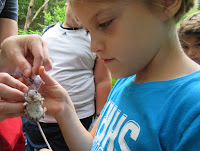
Journey examining a vole during the
Mammal program
In addition to the help of citizen scientists, we had several professional scientists assist with the Biotic Inventory by leading programs about different organisms found on the reserve. Professor Julie Beston from the University of Wisconsin – Stout was one such volunteer. She helped set up live mammal traps to record the number of shrews, voles, red and grey squirrels, chipmunks, white-tailed deer, and martens at the reserve. For the Biotic Inventory Land Snails Program, local snail expert Matt Kuchta, also from the University of Wisconsin – Stout, taught citizen scientists how to survey the forest for snails. Many of the terrestrial snails in Wisconsin are so small that they would barely cover Abraham Lincoln's nose on a penny. Dr. Todd Wellnitz from the University of Wisconsin – Eau Claire taught a handful of our volunteers to locate and identify both aquatic and terrestrial insects in our Biotic Inventory Bug Program. With the help of insect nets, we discovered 33 species of dragonflies, and easily verified the “healthy stream triad” of mayfly, stonefly, and caddisfly nymphs in Deinhammer Creek and Beaver Creek.
Collecting an array of aquatic insects
for the Bug Program
Along with professionals from educational institutions, we were lucky enough to have herptile expert Rori Paloski from the WDNR lead two great programs about reptiles and amphibians. In the reptile program, Rori and a group of volunteers identified several species of snakes using pre-placed reptile cover boards. These cover boards also allowed the group to get up close and personal with a prairie skink and her six eggs. During her amphibian program, Rori discussed the 12 species of frogs that live in Wisconsin and played their calls for participants, before leading a walk in the marsh on the south trails to listen for the calls. By the time the program was finished, participants were able to identify five different frog species just by listening to their call. With all of this help, it is no wonder that our Biotic Inventory was so successful.
We found and held three species of snakes
during the Reptile Program
In addition to collecting excellent scientific data and creating unique citizen science opportunities, this summer’s Biotic Inventory programs were a wonderful time to spend with fellow citizen scientists. We are looking forward to unveiling what we have planned for the next year!

Written by Tera Maldonado
With additions by Alison Campbell
Wednesday, November 30, 2016

New Girl Scout Badge

On November 5th, the Badgerland Girl Scouts unveiled a new badge for their members to strive for at the MAD (Make A Difference) 4 Science Expo in the Wisconsin Dells. This new badge, called the MAD 4 Science Badge, is unique to the Wisconsin area and encourages young girls to get involved in day-to-day science through citizen science projects.
Preview of the new badge

Citizen science is a method of collecting data as regular citizens, often in collaboration with professional scientists, to contribute to ongoing projects. Our very own Jeanette Kelly from the Citizen Science Center at Beaver Creek has been involved in the development of this badge, and was invited to the expo where it was introduced. Jeanette was sought out by the Girl Scout troop because of the opportunities they saw for Beaver Creek to be involved in helping Girl Scouts earn this badge.

Recently, a group of 25 local Girl Scouts gathered to build bluebird houses at Beaver Creek Reserve. Building these houses and learning about bluebirds is one example of a citizen science project that a Girl Scout could engage in to earn this new badge.

With its one-of-a-kind Citizen Science Center facility, Beaver Creek Reserve can allow young girls get involved in the sciences by offering them the chance to help with scientific research. So far, the only similar badge that exists is one for Girl Scouts in Ohio. This is an exciting program to watch unfold because with the related STEM badge that the Badgerland Girl Scouts have already developed, it is likely that more and more young girls will be encouraged to learn about the sciences, and pursue these fields of study.
This is a citizen science project
that could earn the MAD 4
Science Badge


Local Girl Scouts building bluebird houses


You can find more information about the badge and the Badgerland Girl Scouts at www.gsbadgerland.org/ under the Council Patches tab.

Wednesday, November 16, 2016

The Little Free Library is open!

Cyndee Kaiser painting the
Little Free Library
Beaver Creek Reserve has installed its first Little Free Library near the head of the Storybook Nature Trail, next to the Wise Nature Center!

The Little Free Library program began in 2009, just miles away in Hudson, Wisconsin, as a way for Todd Bol, the original creator, to honor his mother, who was a school teacher. Soon after, this idea caught the attention of Rick Brooks at UW-Madison, and collaborating together, the Little Free Library program began, with the mission to “promote literacy and the love of reading by building free book exchanges worldwide and to build a sense of community as we share skills, creativity, and wisdom across generations.” The program accomplishes its mission by having people leave a book or take a book from each box that is installed. Though it started with a goal to build 2,510 Little Free Libraries, the program reached in goal in August 2012, a year and a half ahead of schedule, but it didn’t stop there. As of now, there are over 50,000 Little Free Libraries around the world.

The Little Free Library at Beaver Creek was built by a local Eagle Scout as part of his final project. Cyndee Kaiser generously donated her time once again to paint the Little Free Library, after having painted the mural in the 3M Fledgling Forest in the Wise Nature Center. The idea to put a Library here was brought in by Jeanette Kelly, who wished to honor her late father, Bruce Kelly, a lover of books, nature, and kids. Donations were made in his name to help build the Little Free Library at Beaver Creek. Currently, the Library at Beaver Creek is waiting for a charter number to be assigned and added to the map on the Little Free Library website, but it is already open for use by anyone. Come on down to Beaver Creek, leave a book for someone else, and take a new book to read for yourself.

Information about the Little Free Library program gathered from www.littlefreelibrary.org.